There’s a gap between the interface you designed and the interface your users experience. It’s not a small gap. Most of what you’ve placed on screen — the secondary CTA, the status indicator, the helper text — will never be consciously seen by the majority of people who encounter it.
This isn’t a failure of attention or intelligence on the user’s part. It’s a consequence of biology. Understanding it changes how you think about hierarchy, placement, and what design work is actually for — and it matters most for the interfaces I work on now, where the thing a user most needs to notice is often the AI’s uncertainty cue, the confidence signal, or the route to a human.
The 2-degree cone
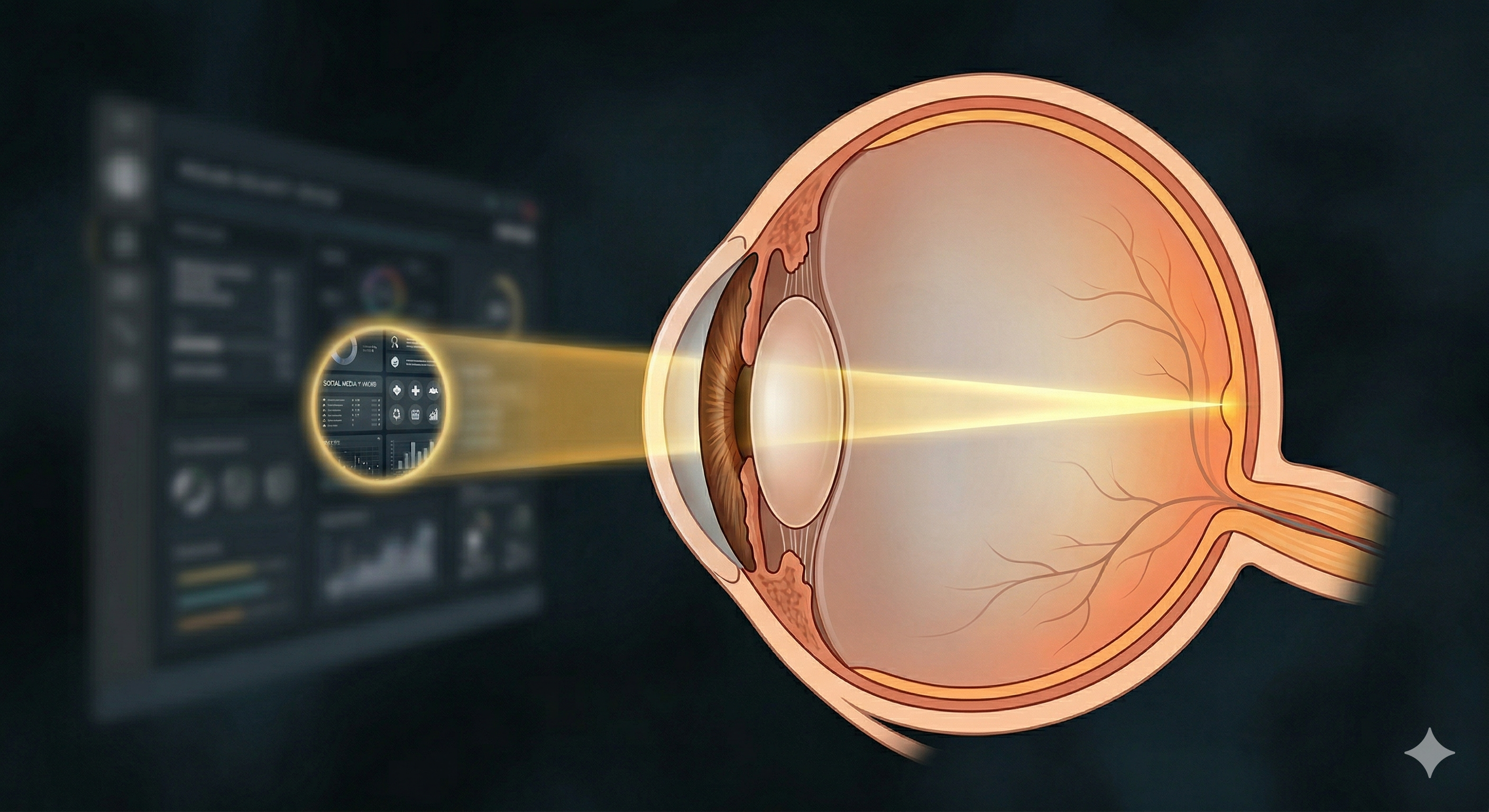
Your eye contains two types of photoreceptors: rods, which handle low-light and peripheral vision, and cones, which handle colour and detail. The highest concentration of cones sits in a small pit at the centre of your retina called the fovea. It covers approximately 2 degrees of your visual field — roughly the size of your thumbnail held at arm’s length.
Everything you’ve ever seen in sharp detail, you’ve seen through that cone. Everything outside it is processed at significantly lower resolution by your peripheral vision.
When you designed the interface, you looked at every part of it. Your fovea swept across the screen, building a high-resolution mental model of the whole. Your users don’t do this. They move their fovea to specific locations — driven by expectation, visual contrast, and task — and rely on peripheral vision to fill in the rest. The peripheral information they receive is enough to navigate, but not enough to notice.
What change blindness reveals
In 1997, Ronald Rensink and colleagues demonstrated something that should trouble every interface designer: people routinely fail to detect significant changes to a scene when those changes occur during a brief visual interruption — a flicker, a cut, a blink (Rensink, O’Regan & Clark, 1997). This became known as change blindness.
The effect is robust and somewhat humbling. In subsequent studies, Simons and Levin (1998) showed that people failed to notice when the person they were having a conversation with was swapped for a different person during a brief obstruction. The brain does not record the visual field like a camera. It records what it attended to.
For interfaces, the implication is direct: elements your users haven’t attended to — haven’t moved their fovea toward — are effectively invisible, even if they’re large, colourful, and technically within view.
Inattentional blindness and the gorilla problem
Change blindness concerns what we fail to notice when things change. Inattentional blindness concerns what we fail to notice when we’re focused on something else.
Simons and Chabris (1999) asked participants to count basketball passes in a video. Halfway through, a person in a gorilla suit walked across the screen, stopped, thumped their chest, and walked off. Around half of participants didn’t notice. They weren’t looking for a gorilla. They were doing a task.
Users on your interface are also doing a task. They’re not looking for your new feature announcement, your updated privacy notice, or the onboarding tooltip you spent three weeks designing. They’re looking for what they came to do. Attention is selective, and task focus makes it more so.
Predictive scanning
Eye tracking research has consistently shown that users scan rather than read interfaces — often heavily front-loading attention to the top and left before trailing off (Nielsen, 2006). More recent work suggests the specific pattern varies by layout and task, but the underlying principle holds: users move their fovea along paths shaped by expectation and prior experience, not by the designer’s intended reading order.
This means users are partly reading what they expect to see rather than what’s there. Alfred Yarbus’s foundational eye movement research showed that what people look at in an image is almost entirely determined by the task they’ve been given. Present the same image with a different question and they look at a different picture (Yarbus, 1967). Your interface is no different — users arrive with a task, and that task filters everything.
Why this matters more for AI interfaces
This is where foveal limits stop being an academic curiosity. In an AI product, the most important thing on screen is often the smallest: the signal that the model is unsure, the prompt to verify before acting, the route to a human. These are exactly the secondary, low-contrast elements the fovea skips.
An AI that hedges honestly in copy the user never reads is, functionally, an AI that didn’t hedge at all — the interface swallowed the safety signal. Designing humble AI — systems that admit what they don’t know — is as much a perception problem as a copy problem. An uncertainty cue only works if it earns foveal attention at the moment it matters.
What this means in practice
Designing with foveal limits in mind means accepting that hierarchy is not decoration — it’s the mechanism by which you direct a spotlight. If something matters, it needs to be where the fovea is likely to go, or it needs to create enough peripheral contrast to earn foveal attention.
A few practical shifts:
Peripheral cues earn foveal attention, they don’t replace it. Motion, high contrast, and spatial positioning in peripheral vision can draw the fovea somewhere it wasn’t heading. Use them deliberately for things that matter; avoid them for everything else, or you’ll exhaust the signal.
Proximity is not noticeability. Two elements can be adjacent on screen while one is foveated and the other is completely unattended. Placing something near a high-attention element does not make it high-attention.
Test for noticeability, not just legibility. Most usability testing checks whether users can read or interact with an element once they’ve found it. Fewer tests check whether they find it at all. First-click tests and five-second tests are blunt instruments for this, but they surface the problem.
Design as if peripheral vision is your first impression. Because for most users, it is. Before the fovea arrives, peripheral vision is already forming a rough sense of structure, contrast, and where to go next.
The interface you designed and the interface your users experience are not the same thing. They never were. The fovea sees what it’s directed to see, and the brain fills in the rest from prediction. The job of hierarchy, contrast, and layout is to direct that spotlight — not to assume it will find everything you’ve built.
References
- Nielsen, J. (2006). F-Shaped Pattern For Reading Web Content. Nielsen Norman Group.
- Rensink, R. A., O’Regan, J. K., & Clark, J. J. (1997). To see or not to see: The need for attention to perceive changes in scenes. Psychological Science, 8(5), 368–373.
- Simons, D. J., & Chabris, C. F. (1999). Gorillas in our midst: Sustained inattentional blindness for dynamic events. Perception, 28(9), 1059–1074.
- Simons, D. J., & Levin, D. T. (1998). Failure to detect changes to people during a real-world interaction. Psychonomic Bulletin & Review, 5(4), 644–649.
- Yarbus, A. L. (1967). Eye Movements and Vision. Plenum Press.